The family of great chess
Small chess, “complete chess”, citadel chess, and Turkish great chess on 13 × 13.
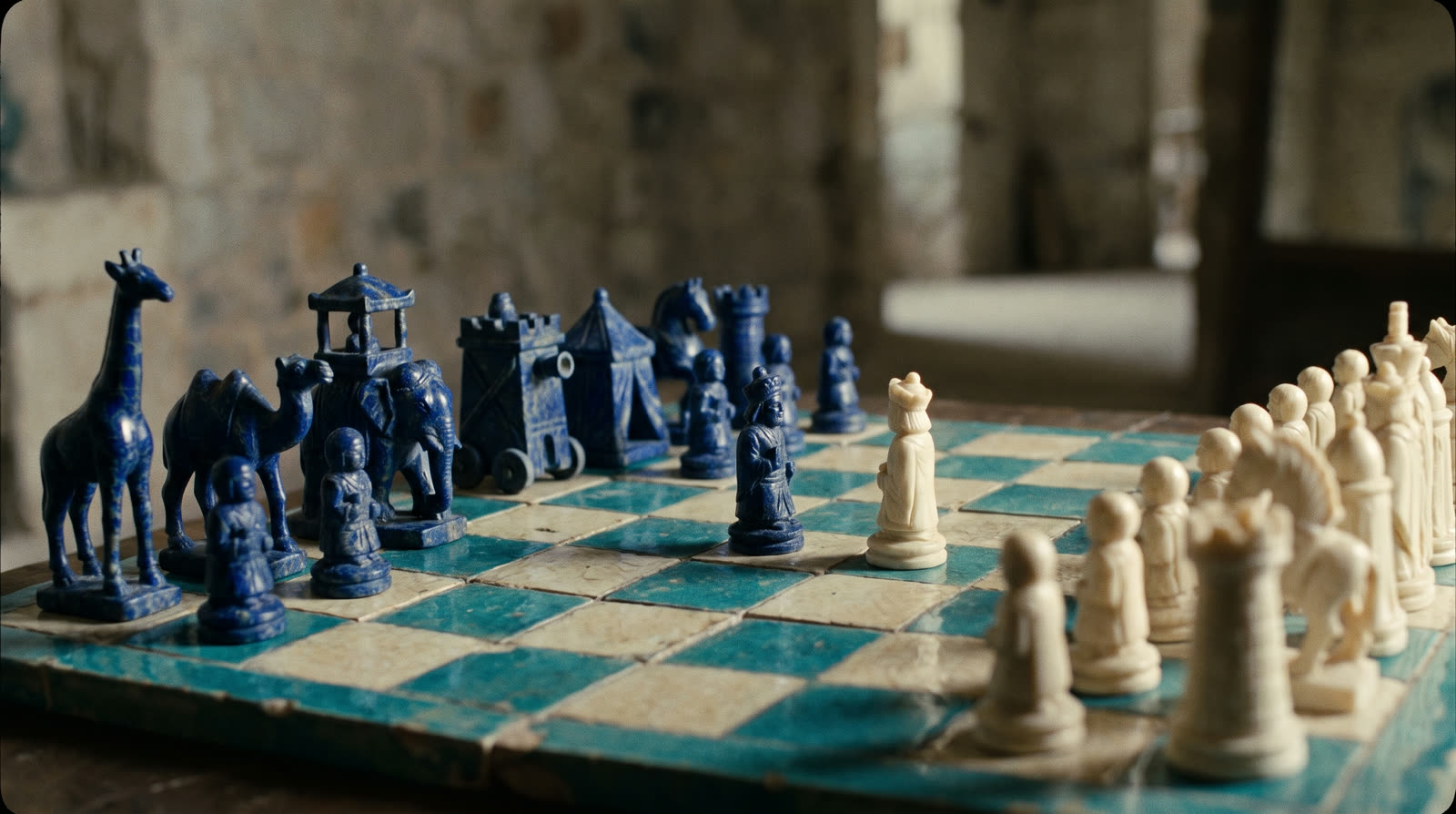
Shatranj on 8 × 8 came to Persia from India and became the basis of all chess in the Islamic world. Larger variants lived beside it. “Complete chess”, shatranj al-tamma, was played on 10 × 10 and added two pieces, the siege machine dabbaba and the camel. “Citadel chess” added corner citadels.
Tamerlane chess combined these ideas on an 11 × 10 board and became the most complex known variant of its time.
Later still, in the early nineteenth century, an Istanbul encyclopedia described a Turkish great chess on 13 × 13 with a rhinoceros (rook plus knight) and a grand vizier (queen plus knight), which shows that large chess lived on long after Timur.
Sources
- Wikipedia: Great chess (Tamerlane chess)
- G. Markov, S. Härtel, “Turkish Great Chess and Chinese Whispers”, Board Game Studies Journal 14 (2020)