Shatranj, the small chess
The game on an 8 × 8 board that everyone at Timur’s court knew, and against which great chess was measured.
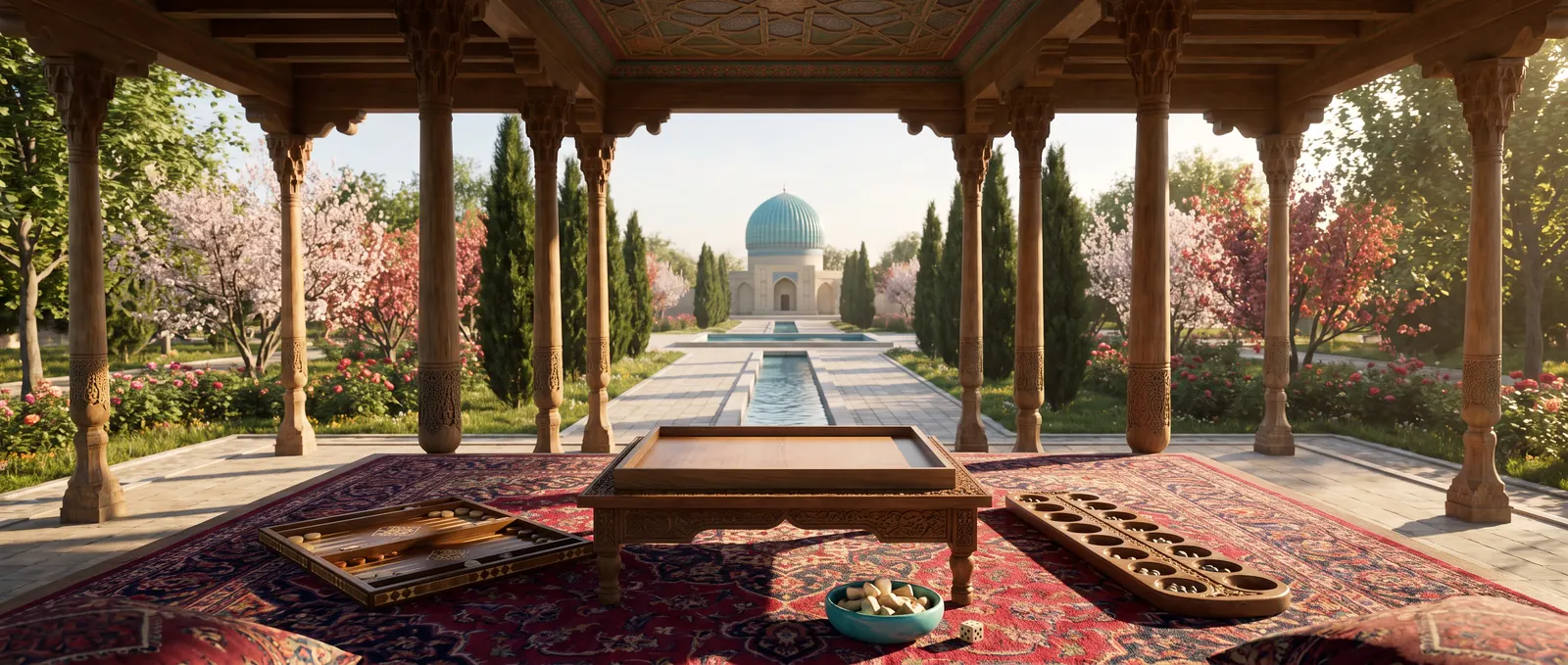
Chess appeared in India around the sixth century as chaturanga. Sasanian Iran called it chatrang, and after the Arab conquest it became shatranj and spread through the whole Islamic world, from al-Andalus to Transoxiana. Europe learned it from Arabs and Persians.
The pieces
The king steps one square in any direction; there is no castling. The ferz, the king’s counsellor, makes a single diagonal step, and the alfil, the war elephant, leaps exactly two squares diagonally over anything in between. The horse and the rukh move as knight and rook do today. A pawn steps one square, never two, and on the last rank becomes a ferz.
The ferz and the alfil are weak, so shatranj is slower than modern chess: the opening is a patient build-up, and masters often began from set opening arrays called tabiyas.
How games were won
Besides checkmate, a player who stalemated the opponent won, as most Arabic authors held. So did a player who left the opponent a bare king without a single piece; if the opponent could bare the other king at once in reply, the game was drawn.
Masters and problems
In ninth and tenth-century Baghdad al-Adli and as-Suli played and wrote books, collecting mansubat, composed positions and studies, beside their games. One position by as-Suli, “as-Suli’s diamond”, stayed unsolved for about a thousand years.
Beside great chess
Shatranj did not vanish under Timur: great chess was the game of the court and of connoisseurs, the small game remained everyone’s. Ali ash-Shatranji, the best player of the age, played both. Much of shatranj passed into Tamerlane chess almost unchanged: the moves of ferz, knight, rook and pawn, promotion, and the win by stalemate.
In our Garden of games shatranj follows the rules collected by Murray in A History of Chess (1913). Draws by threefold repetition and after 70 moves without a capture are our modern addition, so that every game ends.