Asyk, the knucklebone
A sheep’s ankle bone: humanity’s oldest gaming piece and the favourite game of the steppe.
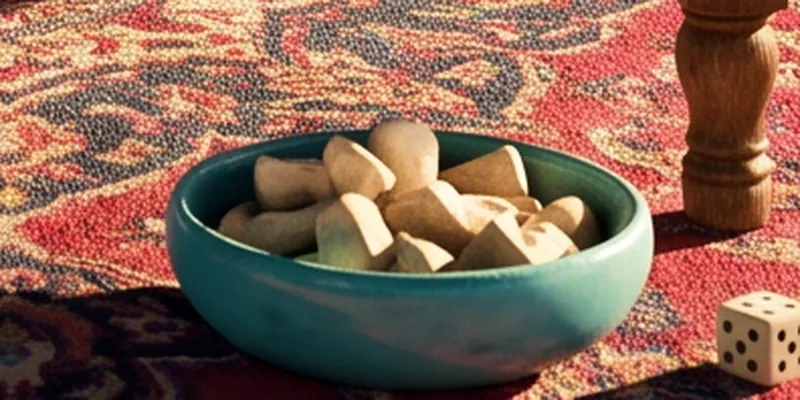
An asyk is the talus bone (astragalus) of a sheep or goat. It can come to rest on four sides, and on the steppe each side has a name. Such bones turn up in excavations from about the fifth millennium BCE, far more often than other bones: they were played with, used for divination and given to children.
Every people has its own name: asyk for Kazakhs, chükö for Kyrgyz, shagai for Mongols, oshiq for Uzbeks, bujulbozi for Tajiks. Ancient Greece and Rome threw the same bone as a die; its broad sides come up about 38 times in a hundred, the narrow ones about 12.
Asyk atu
The best-known steppe game is asyk atu, “shooting the asyks”. Bones stand in a row in the kon, and players take turns striking them with a heavy shooter, the saka, often dyed or filled with lead. Bones knocked across the line go to the shooter, who shoots again. It trains the eye and a steady hand; children and adults play it, and festivals hold whole tournaments.
In 2017 Kazakh asyk games were inscribed on UNESCO’s list of intangible cultural heritage, and Mongolian knuckle-bone shooting in 2014. Our version is simplified: ten bones, a ring and a saka, with physics in place of a dusty yard.
Sources
- Wikipedia: Knucklebones
- UNESCO: Kazakh traditional Assyk games (2017)
- UNESCO: Mongolian knuckle-bone shooting (2014)
- L. E. Maistrov, Probability Theory: A Historical Sketch (Academic Press, 1967)