Herat of Shah Rukh and Baysunghur
The second Timurid capital: the city where the Herat school of painting was born and where shatranj players were painted.
Timur took Herat in 1380 and in 1397 made his youngest son Shah Rukh its governor, the same Shah Rukh who, by tradition, was born during a game of chess. After Timur’s death Shah Rukh and his wife Gawhar Shad moved the capital from Samarkand to Herat in 1405. Gawhar Shad built: a mosque in Mashhad (1418), the Musalla complex and a madrasa in Herat, where her mausoleum stands. After her husband’s death in 1447 she ruled for about ten years in the name of her grandsons, until in 1457, past eighty, she was executed on the orders of Sultan Abu Sa’id.
Baysunghur’s kitabkhana
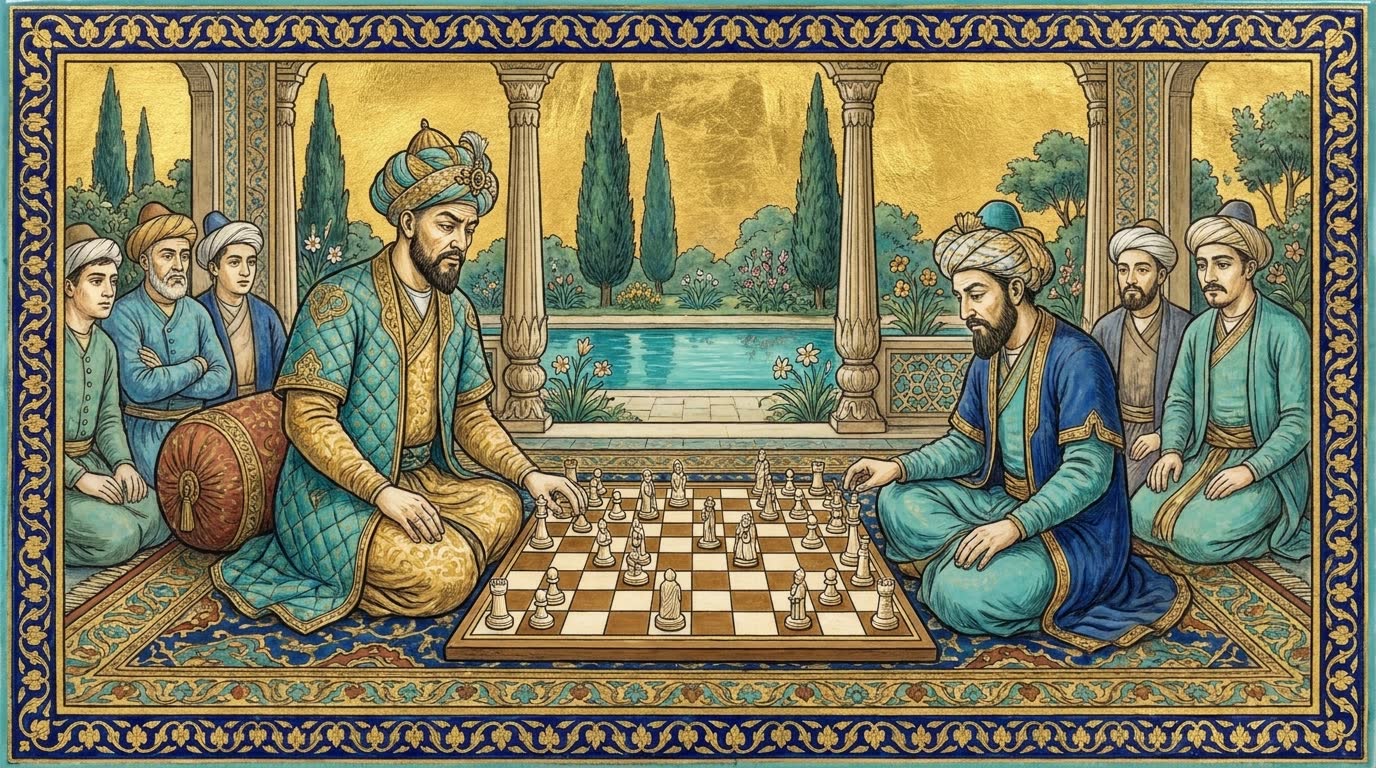
Shah Rukh’s son Baysunghur (1397–1433), himself a fine calligrapher, gathered a book workshop in Herat, a kitabkhana: after the taking of Tabriz in 1421 he brought from there the painters and calligraphers who had worked for the Jalayirids and joined them with masters from Shiraz. The workshop’s chief creation is the Baysunghur Shahnameh, finished on 31 January 1430 and kept in the Golestan Palace in Tehran; UNESCO lists it in the Memory of the World register. Among the Persian miniatures of that same year 1430 there is a picture of two shatranj players.
The flowering
Under Sultan Husayn Bayqara (reigned 1469–1506) and his vizier, the poet Ali-Shir Nava’i, Herat became the most brilliant city of the East: the poet Jami wrote here, and Kamal ud-Din Behzad worked here, whose miniatures are counted the summit of Persian painting. Our library room and the painted pictures of the encyclopedia are a bow to that Herat workshop.