Citadel chess
Shatranj al-husun from al-Amuli’s encyclopaedia: a 10 × 10 board, bishop-like dabbabas and four strongholds at the corners.
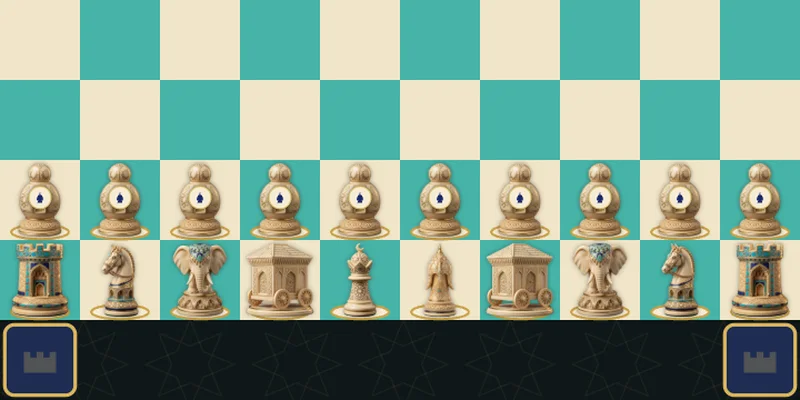
The Persian scholar Muhammad ibn Mahmud al-Amuli included five kinds of chess in his encyclopaedia Nafa’is al-funun (1340s). Three of them, oblong, round and “astronomical” chess, were known before; two he was the first to describe: great chess, which we know as Tamerlane chess, and citadel chess, shatranj al-husun. Wikipedia calls it the most popular of the 10 × 10 variants.
Board and men
Four squares are added to the 10 × 10 board, the husun, “strongholds”, one at each corner. The manuscripts draw them differently: some outside the rukhs’ squares in the first and tenth rows, some directly behind them, some diagonally, as if at the corners of a 12 × 12 board. The army is that of complete chess: two extra pawns and two dabbabas standing between the alfil and the shah and between the alfil and the ferz. But here the dabbaba moves differently, “like the rukh, but aslant”, that is, like the modern bishop. The pawns stand on the second and ninth rows.
The stronghold saves
The citadel squares are the shah’s privilege: a player could at any time draw the game by bringing the shah into one of them, apparently one on the opponent’s side. Murray remarked that adding such refuges was “entirely in accordance with the taste of al-Amuli’s time”: his version of round chess also acquired four citadels in the centre, and in Timur’s great chess a citadel with the same rule stands beside the board.
How we play it
We place the strongholds directly behind the rukhs’ squares, as in the manuscripts Elliott 275, Vienna and British Museum 23555, and the shahs on e1 and e10, as in the same copies. Only a shah may enter a stronghold, and only on the opponent’s half; the game is drawn at once. Murray says nothing of the bare king; following the modern reconstructions, we play without that rule. The rest is as in shatranj.