Oblong chess
Shatranj on a 4 × 16 board where a die decides which piece moves: the earliest known chess played with dice.
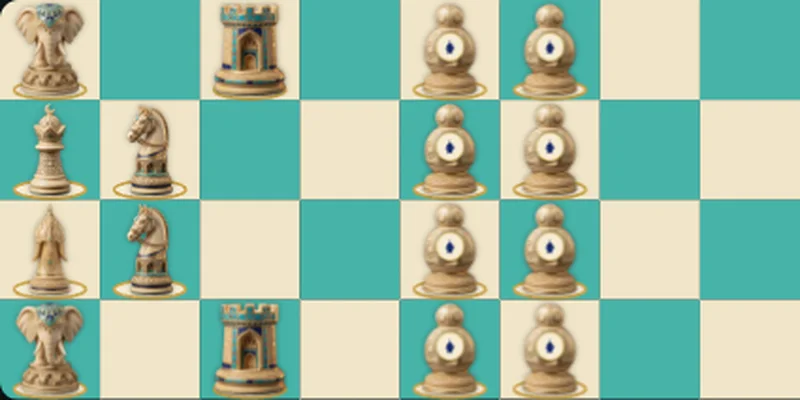
Arabic authors gave the game several names: al-Mas’udi in the tenth century called it al-mustatila, “the oblong”, Ibn Arabshah at-tawila, “the long”, and al-Amuli also al-mamduda, “the stretched”. The board is four squares wide and sixteen long; the men are those of ordinary shatranj and move the same way. The armies stand at the narrow ends, four rows deep.
The die
The difference is the die, the same one used for nard. The manuscripts say: six moves the shah, five the ferz, four the alfil, three the horse, two the rukh, one a pawn. A shah under attack need not run: by the text, the player “cannot play at all until the die gives a six”, so the shah sits in danger waiting for its number, while the opponent waits for the number of the piece that attacks it. The cloth for the game was sewn in two halves with a nard board marked on the back: one mat, two games.
The three Arabic manuscripts that carry the description say outright that they took it from al-Adli, the strongest player of mid-ninth-century Baghdad. So the game existed by 850, and this is the earliest recorded case of a die deciding a move in chess, half a millennium before the European “dice chess”. Murray thought a single die was used and found the game “quite playable, with or without dice”.
At the house of Ali ash-Shatranji
Describing Ali ash-Shatranji, the champion of Timur’s court, the historian Ibn Arabshah writes: “I have seen at his house the round chess and the oblong chess.” So a game from the Baghdad treatises of the ninth century reached Samarkand at the start of the fifteenth.
How we play it
The arrangements in the manuscripts differ; Murray counted seven. We took the one given by the Arabic manuscripts V and Man.: the shah on c1, the ferz on b1, alfils in the corners a1 and d1, horses on b2 and c2, rukhs on a3 and d3, pawns on the fifth and sixth rows; Black stands the same way but turned half round, so its shah lands on b16. With the die, check does not bind and the game ends by taking the shah or by a bare king. Without the die it is ordinary shatranj on a long board.